Why Walmart May Be the Most Important AI Case Study in Public Markets Right Now
A lot of companies talk about AI.
Far fewer have turned it into operating leverage.
That is why Walmart stands out.
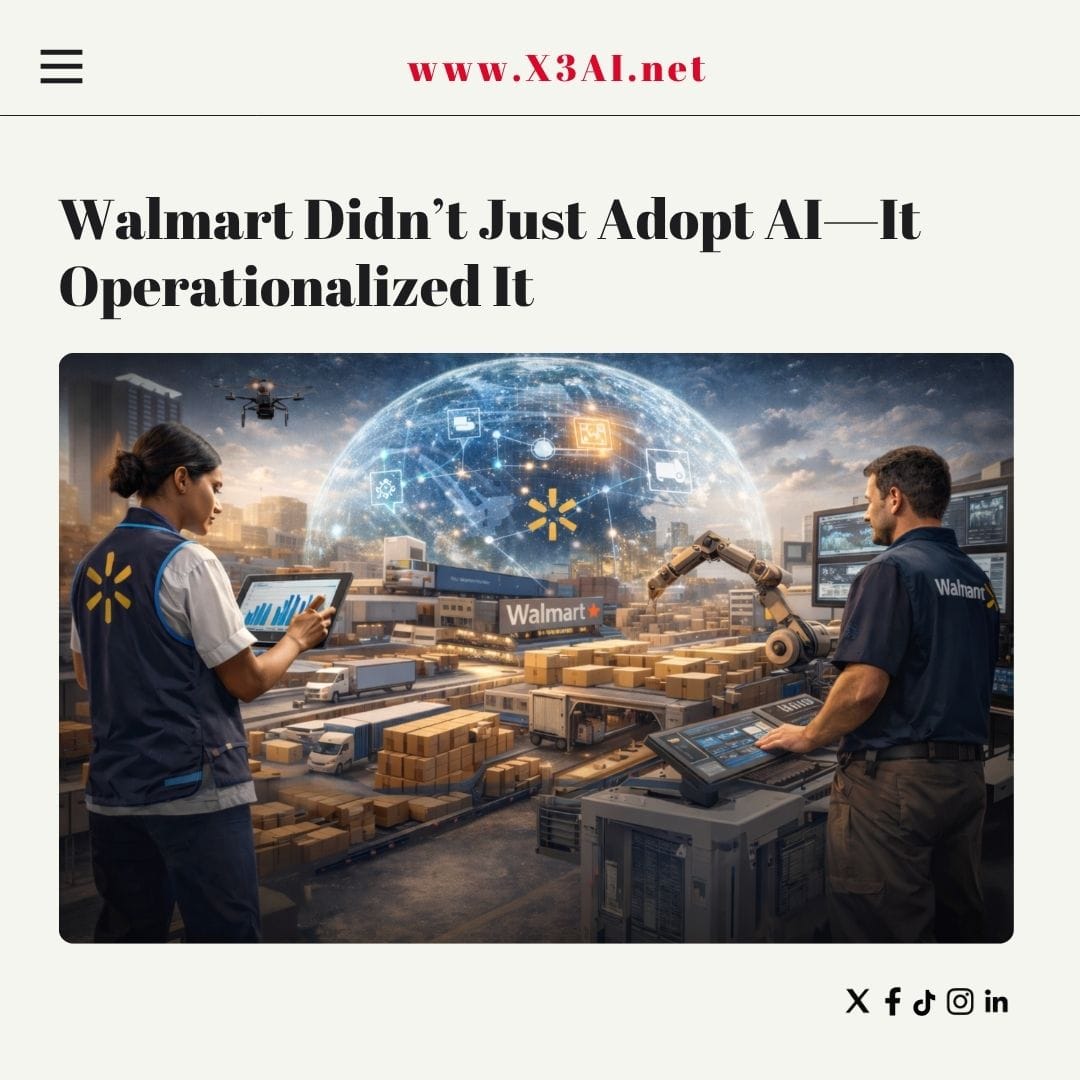
The interesting thing about Walmart’s AI story is not that it has launched a chatbot, or that it is experimenting with generative AI like everyone else. The real story is that Walmart appears to be building AI into the infrastructure of how the business runs: inventory flow, warehouse operations, transportation, merchandising, store labor, and customer shopping experiences. In 2025, Walmart said successful U.S. supply chain capabilities were already being deployed internationally in markets including Costa Rica, Mexico, and Canada, with the cycle compressed from quarters to weeks.
That is a very different proposition from “we ran a pilot.”
It suggests Walmart is trying to standardize AI as a repeatable enterprise capability.
At the center of that strategy is a simple but powerful idea: if a system works in one part of the business, it should be portable across the rest of it. Walmart has described this as taking proven capabilities from its U.S. supply chain playbook and scaling them across geographies. That includes predictive warehouse and transportation systems, self-healing inventory, enterprise inventory visibility, and agentic tools for associates.
One of the clearest examples is inventory.
Walmart says its “Self-Healing Inventory” capability detects stock imbalances and automatically redirects goods to where they are needed most before problems show up in stores. In Mexico City, the company said a single inventory rebalancing system had already generated more than $55 million in savings.
That matters because inventory is where retail economics get brutally real. When stock is in the wrong place, retailers lose sales, tie up working capital, mark down excess product, or disappoint customers. AI is valuable here not because it sounds futuristic, but because it improves one of the most expensive coordination problems in retail. Walmart’s own leadership framed the goal this way in its 2025 investment meeting: improve the ability to anticipate demand, better flow inventory, grow sales, and reduce costs.
The second reason Walmart is worth watching is that it is applying AI at multiple layers of the enterprise at the same time.
In the supply chain, Walmart says predictive warehouse and transportation systems are coordinating fulfillment and optimizing fresh delivery routes to reduce waste and keep food at peak quality. That is especially important in grocery, where execution quality directly affects spoilage, freshness, and last-mile economics.
For store and supply-chain associates, Walmart has described agentic tools that can answer operational questions such as, “What items were shorted in these stores?” and return recommended next steps immediately, cutting hours of manual analysis down to seconds.
For frontline store labor more broadly, Walmart announced in June 2025 that it was deploying AI-powered tools to its U.S. associate base, including task management, translation, and upgraded conversational support. According to Walmart, one AI-directed workflow tool reduced estimated shift-planning time for team leads and store managers from 90 minutes to 30. The company also said its associate conversational AI has more than 900,000 weekly users and handles more than 3 million queries per day.
That is an underappreciated part of the Walmart story.
Most AI commentary focuses on customer-facing use cases because they are easy to demo. But the more consequential gains often come from the middle of the business: planning, exception handling, labor allocation, inventory accuracy, and issue resolution. Those are not glamorous workflows, but they are exactly where a company as large as Walmart can create compounding advantage.
The customer side is evolving too.
At Walmart’s 2025 investment meeting, the company said it was in the early stages of putting agentic AI to work and highlighted “Sparky,” a personal shopping assistant designed to help customers explore products, plan events such as a birthday party, and complete weekly shopping missions. Reuters later reported that Walmart planned to roll out four AI “super agents” for shoppers, employees, suppliers and sellers, and developers, consolidating fragmented tools under a single umbrella.
That is strategically important because it shows Walmart is not treating AI as a side feature. It is treating AI as an interface layer between people and the company.
If that works, the implications are significant. Search becomes conversational. Merchandising becomes more responsive. Customer support becomes more contextual. Internal operations become less dependent on analysts manually stitching together answers from disconnected systems.
There is also a deeper architectural lesson here.
Walmart says its AI tools are powered by Element, its proprietary machine learning platform, which the company says helps it deploy AI rapidly and at scale while emphasizing governance and security. Walmart’s technology team has also described Element as a platform built to avoid vendor lock-in, support multi-cloud deployment, and speed enterprise AI development.
That kind of platform work is not usually the part that gets headlines, but it may be the reason Walmart can move as fast as it does. Many organizations get stuck because their AI efforts remain fragmented: one team builds a support bot, another builds a forecasting model, a third experiments with copilots, and none of it adds up to a coherent system. Walmart appears to be pushing in the opposite direction: shared infrastructure, reusable capabilities, and common interfaces across functions and geographies.
There is an important caveat.
A large share of the most detailed claims available publicly come from Walmart itself, so the company is obviously presenting its strategy in the strongest possible light. Still, the consistency across Walmart’s investor materials, corporate announcements, and independent Reuters reporting makes the broader conclusion hard to ignore: Walmart is no longer just experimenting with AI; it is reorganizing parts of its business around it.
That is why this case matters beyond retail.
The lesson is not “every company should build a shopping assistant.”
The lesson is that enterprise AI starts to matter when it stops being a feature and starts becoming coordination infrastructure.
Walmart’s example suggests the real prize is not generating more text. It is reducing friction between demand, inventory, labor, logistics, and decision-making.
That is where AI stops being theater.
And starts becoming execution.