OpenAI Launches GPT-5.2 as AI Market Faces Stock Performance Pressure
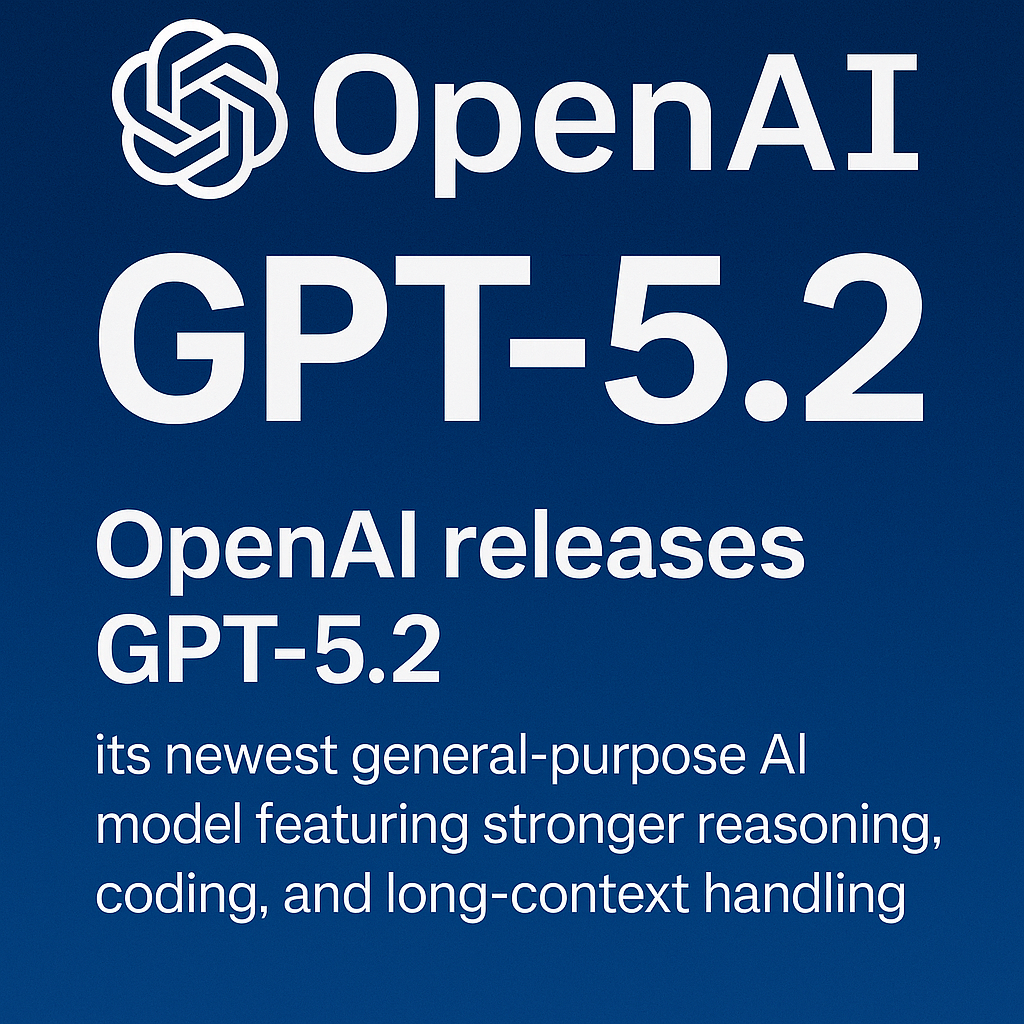
December 12, 2025 — OpenAI this week officially launched GPT-5.2, the next generation of its flagship general-purpose artificial intelligence family, marking a major iteration focused on stronger reasoning, coding, and long-context understanding. The release comes amid intensifying competitive pressure from Google’s AI models and heightened investor scrutiny of AI-related corporate earnings and valuations.
GPT-5.2: What’s New and Why It Matters
OpenAI describes GPT-5.2 as its most capable model yet for “economically valuable” work—targeting real-world professional tasks such as spreadsheet creation, presentation building, multi-document reasoning, and code development. The model suite is rolling out in multiple variants (Instant, Thinking, and Pro) to ChatGPT paid tiers, and will remain part of the OpenAI API alongside older model versions for developers.Reuters+1
Key differentiators highlighted in coverage and official guidance include:
- Enhanced reasoning and long-context handling, enabling better performance on multi-step tasks and sustained workflows.TechStock²
- Improved code generation and tooling support for software developers.Editorialge
- Expanded variant options for different user needs, from low-latency interactions to deeper cognitive tasks.Techmeme
OpenAI’s CEO Sam Altman previously ordered an internal “code red” to accelerate development and redirect resources toward countering competitive pressure from Google’s recently released Gemini models. Though Altman commented that Gemini had “less of an impact” on OpenAI’s metrics than anticipated, the company’s messaging emphasizes practical productivity improvements as a strategic priority.Editorialge
Business Insider notes GPT-5.2’s strong performance metrics on professional task benchmarks, describing it as significantly faster and more cost-effective compared with previous releases in many knowledge-work categories.Business Insider
Strategic Partnerships: Disney’s $1 B Investment
Simultaneously with the GPT-5.2 launch, The Walt Disney Company announced a $1 billion strategic investment in OpenAI. Under the agreement:
- Disney grants OpenAI licensed access to more than 200 characters from marquee franchises like Marvel, Star Wars, and Pixar for use in AI video-generation through OpenAI’s Sora tool.
- Disney will host user-generated content featuring these characters on its platforms and receive equity warrants as part of the deal.
- The deal stipulates that Disney IP may not be used for training core AI models, a point of emphasis in negotiations to protect intellectual property assets.Financial Times
Industry observers frame this alliance as a significant media-to-AI convergence, where entertainment content fuels AI creativity tools and platforms while providing new distribution channels. Disney’s stock reacted positively to the announcement.Financial Times
AI Stocks Under Pressure: Earnings, Valuations, and Investor Sentiment
While major AI product news accelerates, AI-linked equities face renewed volatility as earnings reports and outlooks reveal growth challenges and raise valuation concerns.
Oracle’s Weak Earnings and Sector Impact
Oracle reported results that missed revenue expectations, with softer cloud and infrastructure performance than analysts hoped, prompting sharp declines in its share price and renewed talk of an AI valuation “bubble.” In the aftermath, Oracle’s stock fell sharply—erasing tens of billions in market capitalization and intensifying concern about the sustainability of aggressive AI capital expenditure.The Guardian
Investor reaction was severe: Oracle’s stock dropped by approximately 15–16% in recent trading, and broader tech peers such as Nvidia, AMD, Broadcom, Dell Technologies, and Hewlett Packard Enterprise also saw share price weakness as traders reassessed growth prospects tied to AI spending.Barron's Analysts attributed the sell-off to worries over stretched valuations and high debt levels tied to infrastructure build-outs, spotlighting the risks inherent in scaling AI businesses at rapid pace.Finimize
Broadcom and Other AI-Related Stocks
Similarly, Broadcom’s most recent earnings beat failed to satisfy market expectations for AI backlog and growth commentary, leading to share price declines even as revenue rose. This underscores how investors are increasingly focused not just on topline numbers, but on future AI demand visibility and commentary from executives.AInvest
These dynamics emerged as key corporate earnings reports hit the market, reinforcing that earnings cycles are a central driver of short-term stock performance in the AI sector—especially where valuations are elevated.Investing.com
Investor Sentiment and “AI Bubble” Discussions
The combination of heavy spending, high valuations, and mixed earnings outcomes has led to renewed discussion about potential AI market overheating. Market analysts and some financial commentators describe the current environment as reminiscent of historical tech bubbles, with AI valuation narratives outpacing clear evidence of profit realization in some cases.Wikipedia
This debate is heightened by the weight of AI-oriented companies within major indices and by the dependence of broader market sentiment on continued robust performance from AI leaders.
Conclusion
OpenAI’s GPT-5.2 launch represents a strategic push to reinforce product leadership during a period of intense competition and rapid capability evolution. The linked Disney investment highlights how content and AI intersect commercially. However, broader market conditions emphasize that AI’s transformative potential is being tested not just by technological benchmarks but also by investor confidence, profitability evidence, and execution discipline at major corporations.