Enterprise AI Adoption Trends: From Productivity Gains to Strategic Transformation
December 12, 2025 — As generative artificial intelligence (AI) technologies move well past early experimentation, enterprise adoption is entering a mature phase of measurable impact and strategic integration. Organizations across industries are embedding AI into core workflows, establishing partnerships with leading AI developers, and equipping workforces with skills and platforms designed for the AI era.
AI Moves from Pilot to Production Across Industries
Recent industry analyses show enterprise AI adoption is rapidly becoming mainstream rather than fringe experimentation. Surveys and corporate reports indicate that a large majority of large enterprises are already using AI tools in business processes, and expectations point toward near-universal adoption within a few years. This includes a shift from isolated proofs of concept to enterprise-wide deployments tied directly to business outcomes such as efficiency, revenue growth, and competitive differentiation.Second Talent
Market data suggests that the global generative AI market is expanding sharply, with projections placing its growth to well over $150 billion by 2030 as enterprises invest in AI platforms, agents, and productivity enhancements.glean.com
AI Agents and Workflow Automation Drive Operational Value
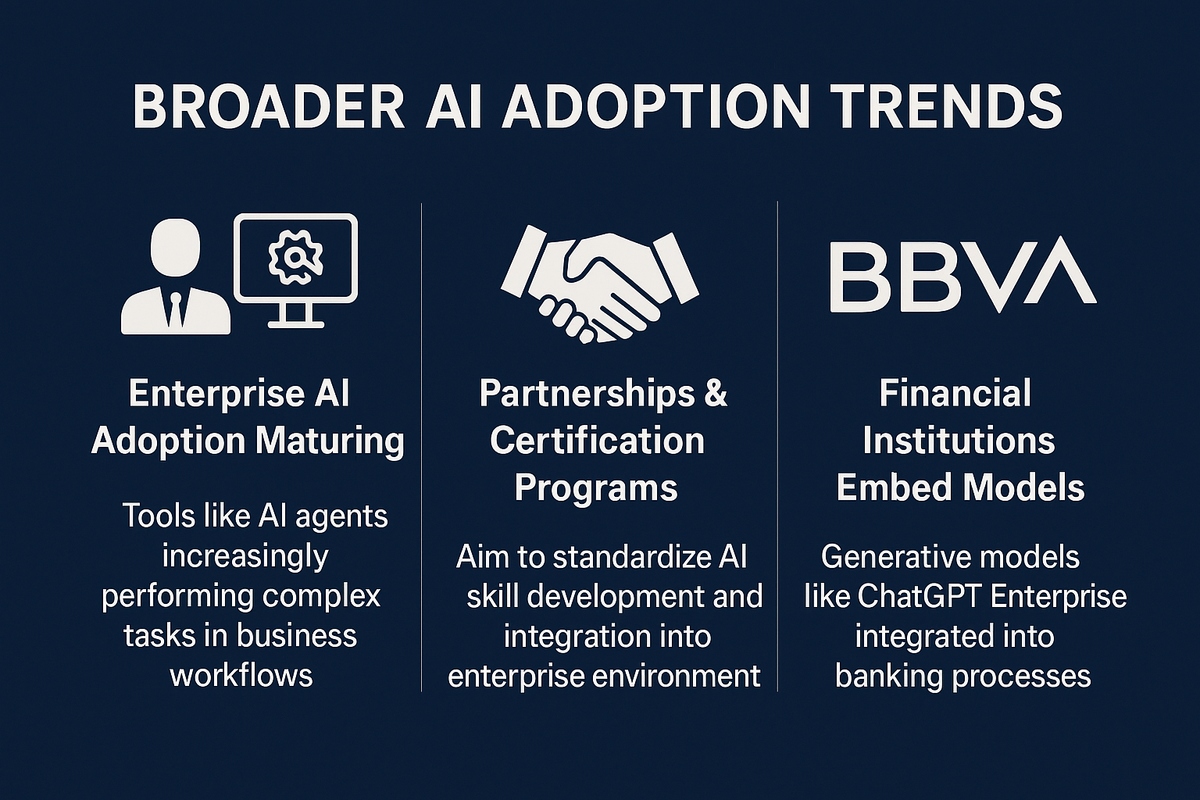
One of the most significant developments in 2025 is the rise of AI agents—intelligent systems capable of executing structured tasks, automating multi-step processes, and acting as “intelligent collaborators” in business environments. Analysts and enterprise strategy reports highlight that AI agents are unlocking new value by automating routine workflows and augmenting decision-making across functions.Accenture
Companies are deploying these agents to handle tasks ranging from customer support and coding assistance to data analysis and automated reporting. While early adoption phases in 2024 focused on experimentation, by 2025 AI agents are increasingly embedded in core systems, becoming a practical part of daily work.Wikipedia
Strategic Partnerships Fuel Adoption and Scale
A defining trend in broader AI adoption is the expansion of strategic collaborations between global consulting firms and AI developers.
- Accenture and Anthropic Partnership: In a multi-year agreement, Accenture has deepened its collaboration with AI developer Anthropic, forming a dedicated business group focused on accelerating enterprise AI deployment and training roughly 30,000 consultants on Anthropic’s Claude models. The partnership highlights how enterprises are investing in both technology access and workforce capabilities to scale AI systematically across industries.Reuters+1
- Accenture and OpenAI Collaboration: In parallel, Accenture is advancing its AI strategy with a wide deployment of ChatGPT Enterprise across its own workforce and client solutions, aiming to integrate agentic AI deeply into consulting and operational workflows.Reuters
These arrangements underscore a broader pattern: third-party partnerships are a key catalyst for adoption, providing enterprises with both technical capabilities and implementation expertise required to transition AI from experiments to strategic assets.
Financial Services: A Case Study in Enterprise AI Integration
The financial sector is among the fastest to adopt AI at scale. Leading global bank BBVA has embedded ChatGPT Enterprise into its core banking workflows, significantly transforming operational processes. The bank’s deployment expanded from an initial pilot to thousands of employees, leading to measurable productivity gains such as nearly three hours saved per employee per week and high engagement rates in enterprise AI usage.AI News+1
BBVA’s approach reflects a broader trend in financial services where generative AI assists with risk analysis, customer service, compliance, and internal decision support, moving beyond task automation to reshape the way work gets done throughout the organization.Evident Insights
Upskilling and Certification Programs Support Workforce Transformation
Enterprises are also investing in AI upskilling and certification programs to ensure that employees can effectively leverage AI tools. Large consulting firms and technology partners are integrating formal training and certification paths into adoption strategies, helping organizations build internal competency and reduce reliance on external consultants.Reuters
This focus on workforce readiness is critical: as AI becomes embedded across functions, employees with AI fluency are increasingly essential for translating technological capabilities into business impact.
Business Impact and the Future of Enterprise AI
Collectively, these developments point to a significant evolution in how AI is applied in enterprises. What started with pilots and proofs of concept has matured into strategic programs that touch nearly every functional area—from finance and operations to customer engagement and product development. The key drivers of this shift include:
- Tangible productivity and efficiency gains, reinforced by metrics and usage data tied directly to business outcomes.Second Talent
- Strategic partnerships that bridge the gap between AI innovation and enterprise execution.www.alphaspread.com
- Workforce transformation programs that equip employees with the skills required to thrive alongside AI.Reuters
Industry analysts project that as enterprises continue to scale AI deployments responsibly—combining governance, skilled talent, and robust platforms—the technology will shift further from a competitive advantage to a business necessity. The organizations that succeed will be those that integrate AI not as a point solution, but as an integral part of their operational strategy and organizational DNA.