
DeepMind’s Automated Science Lab in the UK Signals a New Era of “AI-Native” Discovery
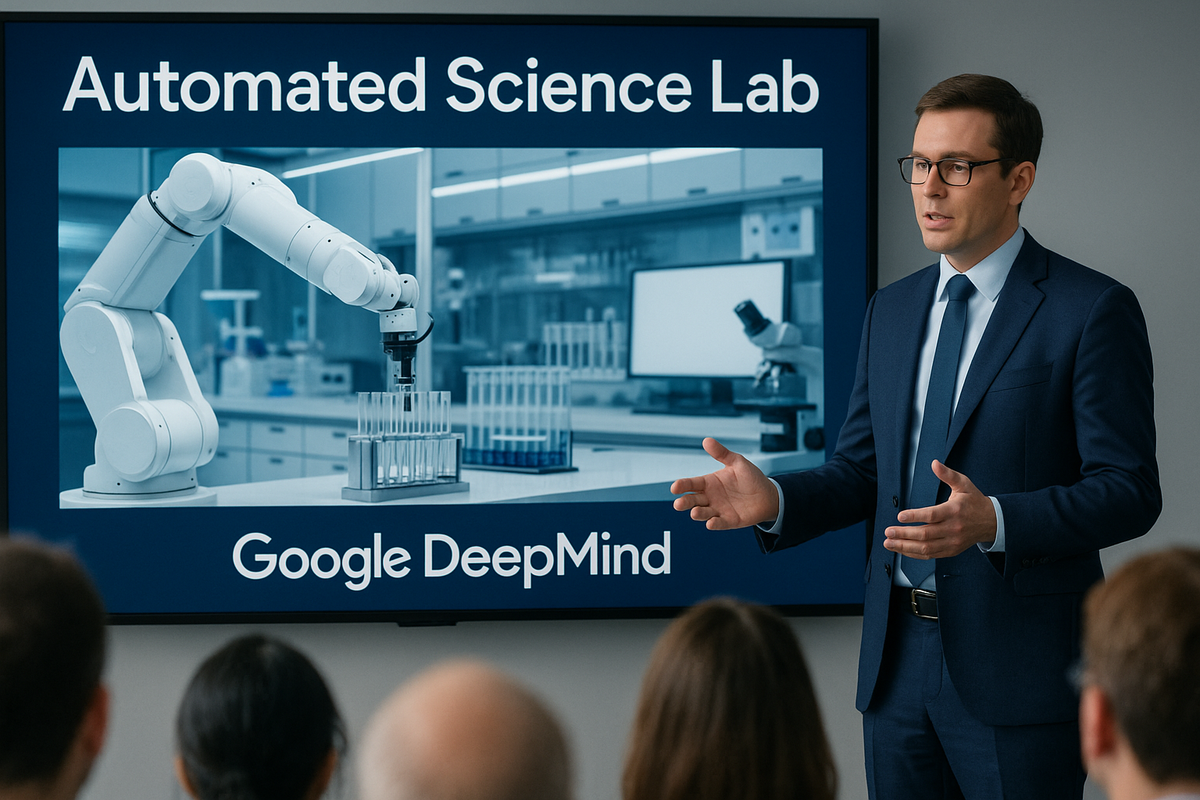
Google DeepMind plans to open its first automated science laboratory in the United Kingdom in 2026, designed from the ground up to fuse robotics-driven experimentation with Gemini-integrated AI systems. The ambition is straightforward but profound: run vastly more experiments per day than a traditional lab and compress years of trial-and-error into dramatically shorter discovery cycles—starting with materials science, including superconductors and other advanced materials relevant to next-generation computing. Google DeepMind+2GOV.UK+2
What DeepMind is building—and what makes it different
Unlike conventional research labs, DeepMind’s facility is being positioned as an end-to-end “automated lab” where robotic systems synthesize and characterize materials at high throughput, while AI helps decide what to try next, interpret results, and iterate rapidly. DeepMind and UK government statements describe a lab architecture intended to evaluate hundreds of candidate materials per day, aiming to shorten the path from hypothesis to validated result. The Guardian+2Google DeepMind+2
DeepMind has framed the initiative as part of a broader UK partnership in which UK researchers receive priority access to certain DeepMind AI-for-science tools—a notable policy lever as governments compete to anchor frontier R&D capabilities domestically. The Times+2GOV.UK+2
Why superconductors are the headline focus
The lab’s initial emphasis on superconducting and other advanced materials is not a branding exercise—it’s a bet that the next big leaps in computing performance and efficiency will be constrained less by software and more by physics.
Superconductors that operate at ambient temperature and pressure are widely considered a “holy grail” because they could enable near-lossless power transmission and unlock novel device architectures. DeepMind’s leadership has explicitly highlighted this target as a long-term scientific aspiration, and the automated lab is being positioned as a machine-speed search engine for that kind of breakthrough. LinkedIn+2Google DeepMind+2
The strategic significance: industry–government alignment around “compute + science”
This project also underscores a broader shift: AI is moving from assistive analytics into active experimental agency—systems that don’t just model outcomes but help generate data through autonomous lab cycles. In practical terms, that is attractive to governments because it aligns three national priorities:
- Scientific competitiveness (faster discovery pipelines)
- Economic productivity (materials breakthroughs feeding chips, batteries, energy systems)
- Security and resilience (domestic access to frontier tools and expertise)
The UK government has presented the partnership as strengthening Britain’s position in science and technology through automated labs and deeper collaboration with a frontier AI lab. GOV.UK+2Computer Weekly+2
What to watch: impact, governance, and who gets access
If DeepMind’s lab works as advertised, the biggest early signal won’t be a single miracle material—it will be measurable acceleration: higher validated hit-rates, reproducible results, and faster iteration from candidate to confirmed properties. Just as important will be governance questions: how safety, transparency, and research access are handled when a private AI lab becomes tightly coupled to public-sector innovation goals. DeepMind has pointed to collaboration with the UK’s AI safety ecosystem alongside the partnership’s expansion. The Times+2Google DeepMind+2
In short, this is not merely a new facility announcement—it is a visible step toward a world where scientific discovery is increasingly executed by AI-orchestrated, robot-run research systems, with national competitiveness riding on who can deploy them responsibly and at scale.