AI Leadership Events Are Accelerating Global Innovation Ecosystems
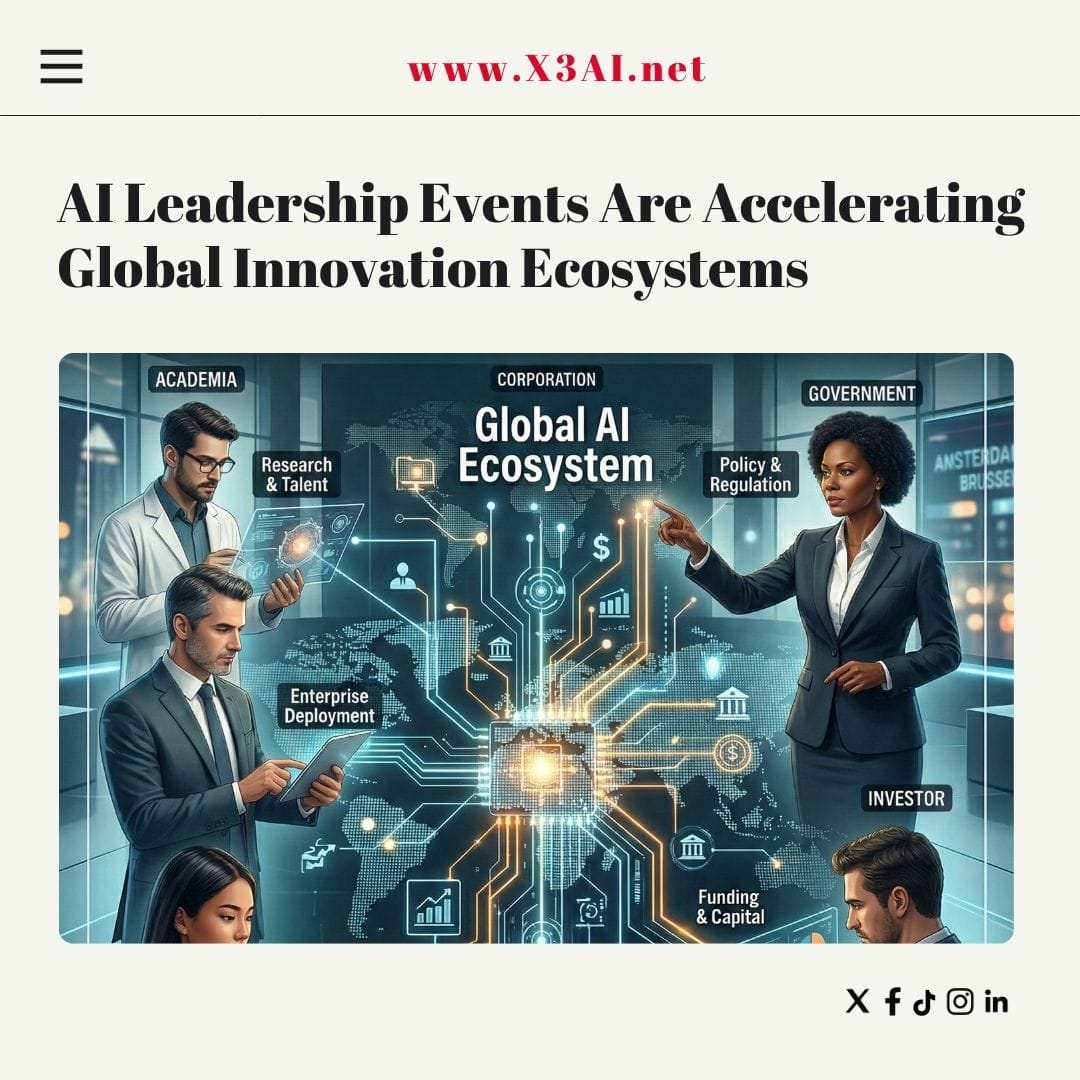
Artificial intelligence is no longer advancing in isolated labs or single companies. Instead, it is being shaped in high-level forums where governments, startups, corporations, investors, and academia converge. Major AI leadership conferences have become strategic infrastructure for the digital age — places where policy is negotiated, partnerships are formed, and the direction of the technology is effectively decided.
From Conferences to Global Coordination Platforms
Events such as the World Summit AI in Amsterdam exemplify this shift. Rather than purely technical gatherings, these summits assemble enterprise leaders, policymakers, researchers, and investors to debate governance, deployment, risks, and opportunities of AI on a global scale. (worldsummit.ai)
The significance lies in who attends: heads of innovation, ministers, venture capitalists, and leading scientists. This cross-sector composition enables decisions that no single institution could implement alone. As a result, conferences increasingly function as coordination hubs for the entire AI ecosystem.
Similarly, international forums like the International AI Summit in Brussels convene policymakers, industry executives, and researchers to discuss AI’s economic and societal impact, underscoring the technology’s role as a geopolitical and economic priority. (AI Summit 2025 -)
Government Engagement Signals Strategic Importance
Government participation has intensified dramatically. Dedicated public-sector events — such as Government Leadership & AI Summits — focus on digital infrastructure, governance frameworks, and national competitiveness. (gitexnigeria.ng)
Multilateral organizations are also heavily involved. For example, the OECD participates in AI summits to advance standards for safe, secure, and trustworthy AI, reflecting how international coordination is becoming essential to managing cross-border risks. (OECD)
In practical terms, these meetings shape regulation, procurement strategies, and national AI roadmaps — decisions that determine how quickly innovation moves from research to real-world deployment.
Startups Gain Access to Capital and Markets
For emerging companies, major AI events are high-stakes gateways to funding, partnerships, and global visibility. Startup competitions, investor matchmaking sessions, and live product demonstrations are now standard features.
At the India AI Impact Summit 2026, startups showcased solutions across healthcare, education, manufacturing, and finance, illustrating AI’s growing role in solving real-world problems. (The Economic Times) The same summit served as a platform for international cooperation and policy dialogue, highlighting how entrepreneurial innovation and state strategy are becoming intertwined. (The Economic Times)
Another example is DeepFest in Saudi Arabia, which has rapidly grown to tens of thousands of attendees and showcases applications ranging from robotics to media technologies, reflecting the scale of investment governments are making to position themselves as AI hubs. (Wikipedia)
Academia Provides Research Depth and Talent Pipelines
Universities and research institutes remain essential participants, contributing cutting-edge science and workforce development. Events hosted or supported by institutions such as MIT bring together experts to examine how AI is transforming industries and societies, bridging theoretical research with commercial application. (uaisummit.mit.edu)
Academic involvement also helps address long-term issues — ethics, sustainability, safety, and workforce transition — that industry alone may underprioritize. Workshops and symposia frequently produce research agendas, standards proposals, and collaborative projects that shape the field for years.
Public-Private Partnerships Are the Real Output
The most tangible outcomes of these gatherings are not keynote speeches but alliances.
At recent summits, governments have announced collaborations with technology firms to build sovereign AI infrastructure, develop multilingual models, and deploy citizen services powered by artificial intelligence. Such partnerships demonstrate how conferences act as deal-making environments rather than merely networking opportunities. (The Times of India)
International cooperation is also accelerating. Bilateral discussions at AI summits have led to cross-border initiatives focused on human-centric and inclusive AI development, reinforcing the technology’s role in diplomacy and economic strategy. (The Economic Times)
Why These Events Matter More Than Ever
Several structural factors explain why leadership forums are becoming central to AI progress:
- AI’s systemic impact: It affects national security, labor markets, healthcare, and education simultaneously.
- Infrastructure requirements: Data centers, energy systems, and compute capacity require coordinated investment.
- Regulatory uncertainty: Governments and industry must align on standards to avoid fragmentation.
- Talent competition: Countries and companies compete globally for scarce expertise.
In essence, AI development now resembles large-scale industrial policy more than traditional software innovation.
The Emergence of a Global AI Ecosystem
Taken together, these events are knitting together what was once a fragmented landscape into a coherent global ecosystem. They accelerate knowledge transfer, align incentives across sectors, and reduce barriers to collaboration.
As artificial intelligence becomes a foundational technology — comparable to electricity or the internet — leadership summits are evolving into the control rooms where its future is negotiated.
The real story is not that AI conferences are growing. It is that they are becoming the operating system of global innovation itself.