Accenture’s $1B AI Bet: The Deal That Signals a New Era for Consulting
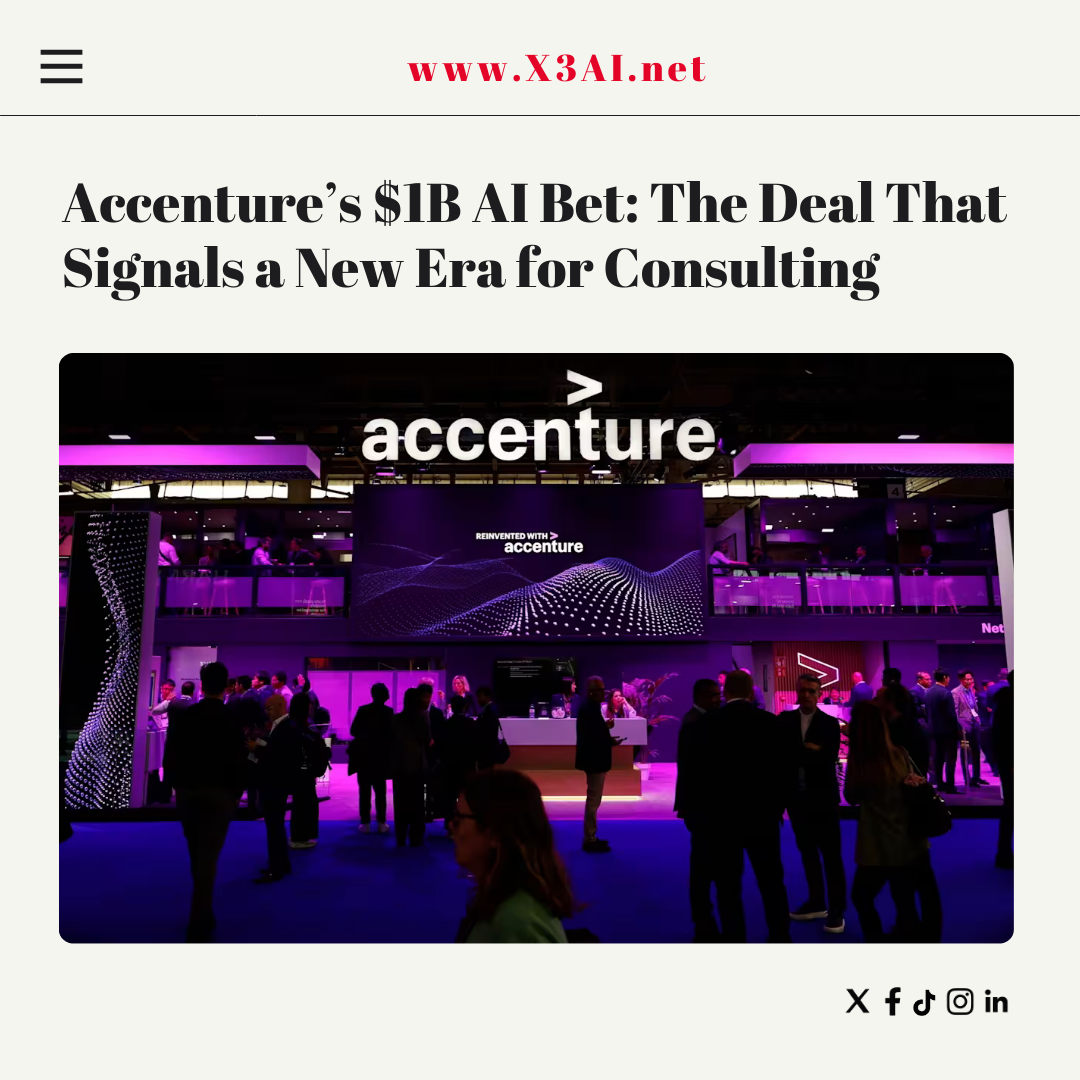
When global consulting giant Accenture agreed to acquire UK-based AI firm Faculty for more than $1 billion, it wasn’t just another tech acquisition. It was a statement.
This deal ranks among the largest private AI acquisitions in the UK and marks a turning point in how professional services firms compete in the age of artificial intelligence: not by advising on AI, but by owning deep AI engineering capability at scale.
Why This Deal Matters
Faculty is not a typical startup. Founded in London, it built its reputation on applied AI in high-stakes environments—from government analytics to mission-critical systems in energy, security, and healthcare. Its teams focus on decision intelligence, model safety, and real-world deployment rather than experimental labs.
For Accenture, the acquisition does three strategic things at once:
- Adds elite AI engineering talent at a time when that talent is scarce and expensive.
- Moves the firm closer to execution, not just advisory work.
- Strengthens its credibility in responsible AI, a growing requirement for enterprise and public-sector clients.
This is consulting’s shift from PowerPoint to production.
Interesting Fact
Faculty’s CEO, Marc Warner, will step directly into Accenture’s global leadership as Chief Technology Officer—a rare move where a startup founder transitions straight into the top technical role of a company with over 700,000 employees worldwide.
That alone signals that this is not an “acqui-hire.”
It is a strategic reset of Accenture’s AI DNA.
The Bigger Picture: Consulting Is Being Rewritten by AI
This acquisition reflects a broader industry trend:
- Clients no longer want AI strategy decks.
- They want working systems, embedded into operations, compliant with regulation, and measurable in ROI.
The traditional consulting model—advise, hand over, move on—is being replaced by something closer to AI systems integration: build, deploy, maintain, and continuously optimize.
In that context, buying Faculty is less about growth and more about survival in the next consulting cycle.
A $1B Signal to the Market
The price tag matters. A billion-dollar valuation for an applied-AI firm sends a clear message:
- AI engineering is now core infrastructure, not an innovation side project.
- The real value is not in models alone, but in operationalizing AI safely and at scale.
- Large enterprises are willing to pay for partners who can deliver that end-to-end.
This mirrors a wider pattern: as AI moves from experimentation to enterprise backbone, acquisitions are replacing partnerships. Control matters.
What This Means for Enterprises
For business leaders watching this deal, the implications are practical:
- Expect consulting firms to compete less on slides and more on code, platforms, and delivery teams.
- Expect AI capability to become a board-level acquisition topic, not just an IT investment.
- Expect the line between consulting, systems integration, and product development to keep blurring.
In short, the consulting industry is quietly transforming into a global AI engineering ecosystem.
Final Thought
Accenture’s acquisition of Faculty is not just about buying a company.
It is about buying the future operating model of consulting.
In the next decade, the winners in professional services will not be those who best explain AI.
They will be those who build it, deploy it, govern it, and scale it inside the world’s largest organizations.
And this $1B deal may be remembered as one of the first clear signals that the race has already begun.